



Does the Mazda3 Come With 4-Wheel Drive?
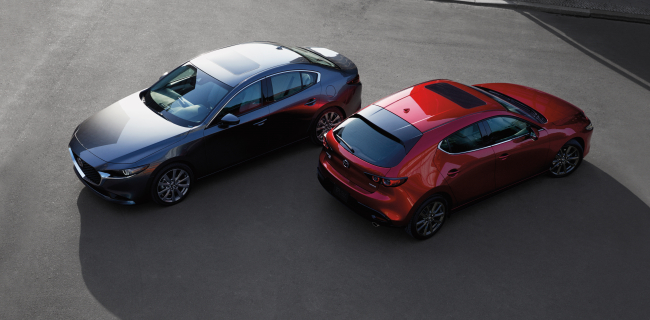
If you’re researching a 4 wheel drive Mazda 3, it’s helpful to understand how Mazda approaches traction and drivetrain performance. The Mazda3 offers front-wheel drive as standard on many configurations, while Mazda’s i-ACTIV AWD system is available on select trims. Exact availability depends on the model year and configuration. Although people often use the terms interchangeably, the Mazda3 uses an all-wheel-drive system rather than a traditional four-wheel-drive setup commonly found in trucks and off-road vehicles.
Understanding the differences between these drivetrains can help you decide which Mazda3 configuration makes the most sense for your driving habits.
What’s the Difference Between Front-Wheel Drive and All-Wheel Drive?
Front-wheel drive and all-wheel drive serve the same basic purpose of helping a vehicle move efficiently, but they distribute engine power differently. That difference can affect traction, handling, and performance in certain road conditions.
Front-wheel drive (FWD) sends engine power to the front wheels, which handle both steering and propulsion. This layout is common in compact cars because it keeps the drivetrain relatively lightweight and can contribute to good fuel economy. For everyday commuting, city driving, and highway travel, FWD offers a practical balance of efficiency and dependable handling.
Front-wheel drive can also perform well on wet roads when the vehicle has suitable tires and the driver adjusts to the conditions. However, traction may become more challenging on particularly slippery surfaces, such as roads covered in snow or ice.
All-wheel drive (AWD) can send power to both the front and rear wheels, helping the vehicle maintain traction when grip varies across the road surface. This can be especially useful when accelerating on wet pavement, navigating uneven surfaces, or driving in areas that experience occasional winter weather.
The Mazda3’s available i-ACTIV AWD system monitors driving conditions and helps adjust power distribution to support traction. Rather than simply reacting to obvious wheelspin, the system uses information about the vehicle’s operating conditions to anticipate changing traction needs.
It’s important to remember that AWD doesn’t make a vehicle immune to slippery roads. Tires remain a major factor in grip and braking, and drivers still need to maintain appropriate speeds and following distances. The best drivetrain choice ultimately depends on local weather, road conditions, and everyday driving needs.
What Other Mazda Models Offer All-Wheel Drive?
The Mazda3 is one of several vehicles in the Mazda lineup that offer available all-wheel drive. Drivers who appreciate Mazda’s approach to handling and interior design may also find an SUV better suited to their passenger or cargo needs.
Here are several Mazda models worth knowing about:
- Mazda CX-30: This compact crossover combines manageable dimensions with a higher seating position and versatile cargo space. Available AWD adds another layer of traction capability for everyday driving.
- Mazda CX-5: With its comfortable interior and flexible cargo area, the CX-5 is a popular option for commuters and families who want the practicality of a compact SUV.
- Mazda CX-50: The CX-50 offers a rugged design and a versatile cabin, making it appealing to drivers who enjoy road trips and outdoor activities.
- Mazda CX-90: For those who need additional passenger room, the CX-90 provides three-row seating and a more spacious SUV layout.
While AWD is available across several Mazda models, equipment can differ by model year and trim. Comparing individual configurations is important when a specific drivetrain is a priority.
Body style also plays a role in the decision. The Mazda3 appeals to drivers who prefer the lower profile and agile feel of a compact car, while Mazda’s SUV lineup offers varying levels of ground clearance, passenger capacity, and cargo flexibility.
Is the Mazda3 AWD a Good Fit for Everyday Driving?
For drivers who want a compact car that balances engaging handling with added traction capability, an AWD-equipped Mazda3 can be an appealing option. Its compact dimensions make it well suited to commuting and navigating busy streets, while the available i-ACTIV AWD system can provide additional support when road conditions become less predictable.
The decision between FWD and AWD often comes down to the environment in which the car will be driven. In regions where roads are generally dry and winter weather is uncommon, FWD may offer all the capability a driver needs. In areas with frequent rain, occasional snow, or changing road surfaces, AWD may be worth considering.
There are trade-offs to keep in mind, too. AWD-equipped vehicles may cost more than comparable FWD versions and can have different fuel-economy ratings. The added traction can be useful, but it doesn’t replace careful driving or appropriate tires.
For anyone researching a 4 wheel drive Mazda 3, understanding these differences provides a clearer picture of what the available AWD system offers and how it fits into the Mazda3’s overall design. The right configuration depends on the balance of efficiency, traction, and everyday practicality that matters most to the driver.